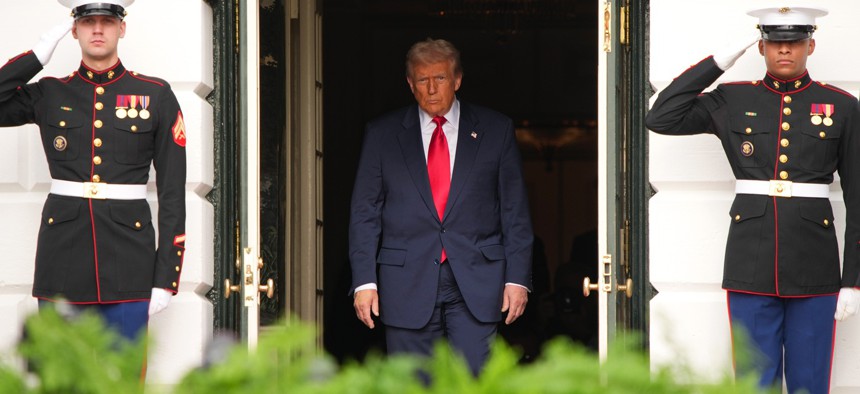
U.S. President Donald Trump arrives to welcome Crown Prince and Prime Minister Mohammed bin Salman of Saudi Arabia to the White House on November 18, 2025 in Washington, DC. Andrew Harnik/Getty Images
 By Alexandra Kelley,
Staff Correspondent, Nextgov/FCW
|
A draft of a new executive order would withhold federal funding from states with artificial intelligence regulations that are deemed overly punitive or in violation of the First Amendment.
President Donald Trump is weighing an executive order that would disincentivize states from passing any new artificial intelligence regulations by withholding federal funding from noncompliant states.
In a circulated draft of the order — titled “Eliminating State Law Obstruction of National AI Policy” — Trump stresses his administration’s light-touch regulatory preference, saying U.S.-made AI products need an industry-friendly environment to lead globally, and having “50 discordant” state laws governing these technologies will hinder this mission.
“American AI companies must be free to innovate without cumbersome regulation,” the draft order reads. “But State legislatures have introduced over 1,000 AI bills that threaten to undermine that innovative culture.”
Notably, the order would restrict various federal funding programs for states if their domestic AI laws are found to hinder the administration’s AI policy. The Department of Commerce would be tasked with evaluating potentially “onerous” state AI laws, along with AI and Crypto Czar David Sacks.
These evaluations will specifically look at laws that require AI models to potentially alter their outputs in ways that could violate the First Amendment. States’s eligibility for select federal funds will be dependent upon the results of these evaluations.
Funding under programs like the Broadband Equity Access and Deployment Program would become dependent on states’ AI regulatory landscapes. Other agencies would be instructed to “take immediate steps” to evaluate states that are not eligible for their funding and grant programs if their AI policies are in conflict with the Trump administration’s posture.
Current language in the draft order also asks the chairman of the Federal Communications Commission to work with Sacks to determine whether to craft and adopt a federal reporting and disclosure standard for AI models that preempts conflicting state laws after the evaluations are complete. It also directs Sacks and the director of the White House Office of Legislative Affairs to create a legislative recommendation establishing a unifying federal regulatory framework for AI.
A 10-year federal preemption of potentially disjointed state laws regulating AI use, development and deployment appeared before Congress earlier this year in its reconciliation bill, where it divided lawmakers on how best to federally govern AI, while also acknowledging states’ rights to govern emerging technology in their respective localities. That provision was ultimately removed from the final text.
As was the case with the moratorium before Congress, advocacy groups and think tanks are split on potential White House intervention. The Tech Oversight Project said that many state laws work to protect minors using AI products, and the Trump administration’s preemption posture undermines online child safety.
“Trump’s proposal to strip away these critical protections, which have no federal equivalent, threatens to create a taxpayer-funded death panel that will determine whether kids live or die when they decide what state laws will actually apply,” Sacha Haworth, executive director of The Tech Oversight Project, said in a statement. “We’re in a fight to determine who will benefit from AI: Big Tech CEOs or the American people.”
Alternatively, nonprofit think tank R Street Institute said that federal pressure could wrangle contradictory state laws into a more unified landscape.
“The Trump administration is clearly fully engaged now on the problems associated with a costly, confusing 50-state crazy-quilt of AI regulations,” Adam Thierer, a senior fellow at R Street, told Nextgov/FCW. “In the end, however, Congress will need to step up and act because Executive Branch authority to address this problem can only be stretched so far, and Executive Orders only last as long as administrations do.”