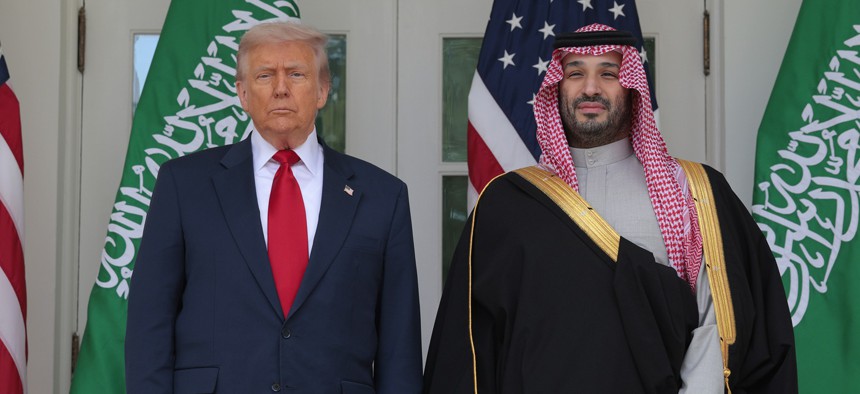
U.S. President Donald Trump (L) and Crown Prince and Prime Minister Mohammed bin Salman of Saudi Arabia pause for photographs along the West Wing Colonnade at the White House on November 18, 2025 in Washington, DC. Chip Somodevilla/Getty Images
 By Alexandra Kelley,
Staff Correspondent, Nextgov/FCW
|
The memorandum allows Saudi Arabia to have access to U.S. tech systems, according to a White House fact sheet.
The Tuesday meeting between U.S. President Donald Trump and Saudi Arabian Crown Prince Mohammed bin Salman resulted in a new memorandum of understanding between the two countries focused completely on artificial intelligence, among other agreements in related tech policy arenas.
Announced late Tuesday, the AI Memorandum of Understanding will give Saudi Arabia access to U.S. technology systems, with the assurance that these systems are protected from adversaries’ use. Granting this access aims to promote the U.S. technology stack abroad, a policy industry heavyweights have championed.
The White House said no further details about the memorandum were available at this time when asked for comment.
Other deals Trump and bin Salman struck following Tuesday’s visit include a Critical Minerals Framework that aims to fortify supply chains for the critical minerals that are integral to technology devices like computing chips and batteries.
Trump said during a press conference following the memorandum’s announcement that his administration is working on approving export licenses for select advanced computing chips to Saudi Arabia.
“Saudi Arabia has a huge demand of…computing power,” bin Salman said. “We’re going to spend in the short term $50 billion by consuming those semiconductors.”
Bin Salman added that Saudi Arabia intends to link this growing demand to U.S. private sector companies.
Supercomputing chips have dominated tech policy conversations within the White House and in Congress. Lawmakers and administration officials are trying to strike a balance between allowing U.S. chip manufacturers like NVIDIA and Microsoft access to the lucrative Chinese market to boost both company profits and U.S.-made AI devices’ global dissemination, while employing sufficient national security protocols to keep advanced technologies out of adversaries’ hands.
Trump said Tuesday that the U.S. AI industry is “leading by a lot” and that key technological rival China is coming in at second place.