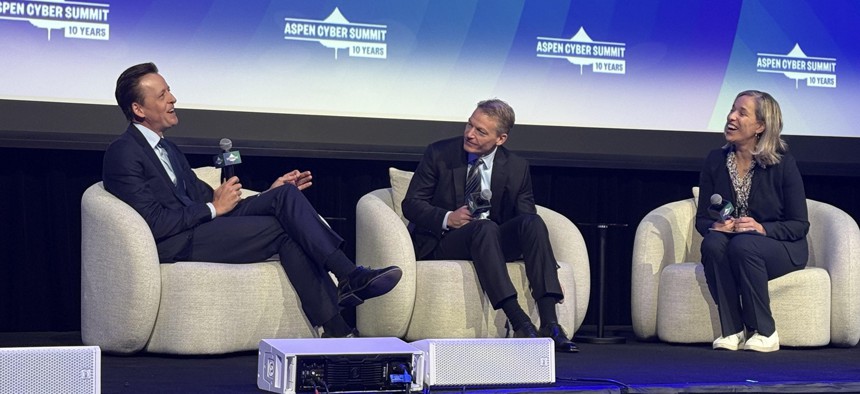
National Cyber Director Sean Cairncross (L) speaks to Mandiant Founder and Ballistic Ventures General Partner Kevin Mandia and Aspen Digital Senior Director of Cybersecurity Programs Sasha O’Connell at the Aspen Cyber Summit on Nov. 18. David DiMolfetta/Staff
 By David DiMolfetta,
Cybersecurity Reporter, Nextgov/FCW
|
“It’s going to be a short statement of intent and policy, and then it will be paired very quickly with action items and deliverables under that,” National Cyber Director Sean Cairncross explained.
The Trump administration’s national cybersecurity strategy is expected to be shorter than the Biden administration’s sweeping version released in 2023, and will focus more on ensuring that cyber adversaries’ behavior does not occur without ample U.S. responses, National Cyber Director Sean Cairncross said Tuesday.
The strategy is coming “as quickly as possible,” he told an audience at the Aspen Institute’s Cyber Summit in Washington, D.C., though he did not give an exact timeframe for its release.
“It’s going to be a short statement of intent and policy, and then it will be paired very quickly with action items and deliverables under that,” he said. “As a top-line matter, it’s going to be focused on shaping adversary behavior, introducing costs and consequences into this mix. I think, as a country, we’ve not done a terrific job of sending a signal to our adversaries that this behavior is not consequence-free.”
The remarks reflect a desire in the second Trump era to craft a more forceful approach to acting offensively in cyberspace. For nearly a year now, Trump allies and officials have contended that the U.S. has not adequately responded to cyberattacks from foreign adversaries, namely from China.
U.S. agencies like NSA, Cyber Command and the FBI have numerous authorities available that allow them to intrude into foreign networks.
Brett Leatherman, the FBI’s top cybersecurity official, also said at Aspen that the FBI and other interagency partners have “seen the entirety” of the strategy.
The Office of the National Cyber Director was created in the Biden administration, and its flagship national cyber strategy was unveiled in March 2023. The Biden-era version of the document showed a greater desire to regulate key areas of the government to make the U.S. more secure from hackers.
The Trump 2.0 strategy is likely to be more friendly to the private sector. Last month, Cairncross said that the White House is seeking more buy-in on strategy development from cybersecurity companies that provide hefty contracting support to many U.S. government agencies, including offices in the Defense Department and intelligence community.